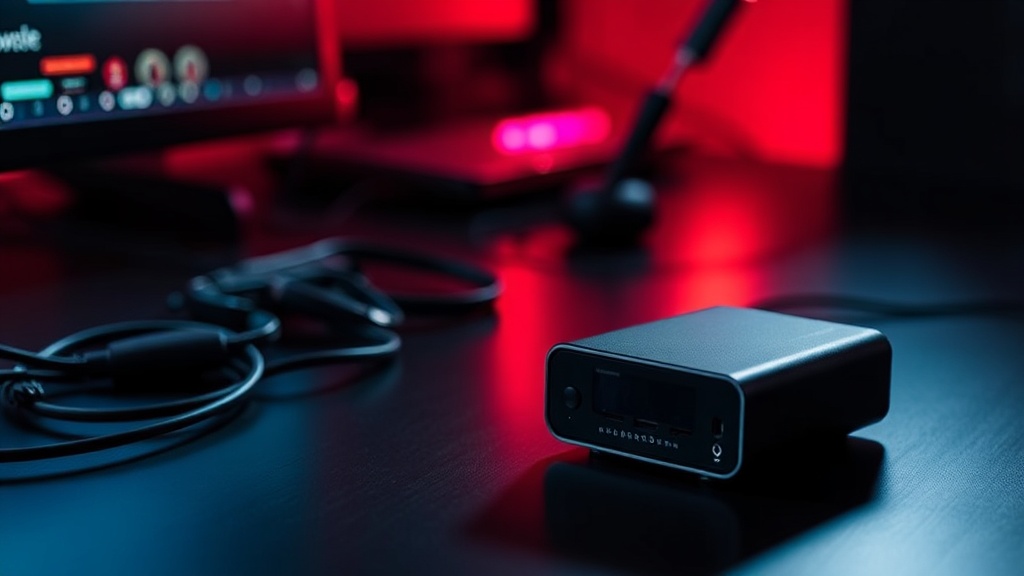
Why You Should Use a Dedicated Portable DAC for Your Music

Overcoming Internal Hardware Limitations
Better Signal-to-Noise Ratio
Driving High-Impedance Headphones
Preserving Your High-Res Audio Files
Are you wondering if that $300 pair of high-impedance headphones is actually performing to its potential when plugged directly into your smartphone or laptop? Most consumers assume that if a device has a 3.5mm jack or a USB-C port, the audio quality will be sufficient. This is a misconception driven by marketing, not engineering. This post explains the technical necessity of a dedicated portable Digital-to-Analog Converter (DAC) and why relying on integrated mobile audio components results in measurable signal degradation and wasted hardware investment.
The Engineering Reality of Integrated Audio
When a manufacturer like Apple or Samsung designs a smartphone, the primary goal is space efficiency and cost reduction. Every millimeter of internal real estate is contested by the battery, the camera modules, and the cellular modem. Consequently, the audio components—the DAC and the amplifier—are often relegated to the lowest tier of components. These integrated chips are designed to be "good enough" for standard earbuds, but they lack the precision required for high-fidelity audio.
In my experience testing hardware, the biggest issue isn't just the quality of the sound, but the signal-to-noise ratio (SNR). Inside a mobile device, the audio signal is surrounded by a chaotic environment of electromagnetic interference (EMI). The cellular radio, the Wi-Fi chip, and the high-speed processor all generate electrical noise. When you use an integrated jack, that noise often leaks into the analog signal path, resulting in a subtle but audible "hiss" or a loss of dynamic range. A dedicated portable DAC moves this process outside the "noisy" chassis of your phone, providing a clean, isolated environment for signal conversion.
1. Superior Signal-to-Noise Ratio (SNR) and Lower Noise Floor
The noise floor is the level of background noise present in an audio system when no music is playing. In cheap integrated circuits, this floor is relatively high. If you are using sensitive In-Ear Monitors (IEMs) like the Sennheiser IE series or high-end IEMs from Moondrop, you will likely hear a constant white noise or static hiss when the music stops. This is a direct result of poor shielding and low-quality voltage regulation.
A dedicated DAC, such as the AudioQuest DragonFly or the iFi Hip-dac, utilizes high-precision components designed specifically to keep the noise floor as close to zero as possible. By isolating the digital-to-analog conversion process from the smartphone's mainboard, these devices ensure that the only thing you hear is the music, not the electrical interference from your 5G modem or CPU spikes. This is not just a "feeling"; it is a measurable difference in decibels that can be verified with an oscilloscope.
2. Higher Resolution and Bit-Depth Support
Standard mobile audio outputs are often capped at 16-bit/44.1kHz (CD quality). While this covers most streaming services, it fails to leverage the true potential of high-resolution files found on platforms like Tidal or Qobuz. If you are listening to 24-bit/192kHz FLAC files, an integrated mobile DAC may downsample or truncate that data, effectively stripping away the detail you paid for.
Dedicated portable DACs are built to handle much higher bit-depths and sampling rates. A device like the Chord Mojo 2 or the FiiO Q series can process much larger data streams without breaking a sweat. This allows for more accurate reproduction of micro-details—the subtle decay of a piano note or the breath of a vocalist—which are often lost when the hardware cannot keep up with the file's complexity.
3. Increased Power Output for High-Impedance Headphones
This is where most mobile users hit a wall. Many audiophile-grade headphones, such as the Beyerdynamic DT 990 Pro or the Sennheiser HD 600, have high impedance (measured in Ohms). These headphones require significantly more voltage to drive the drivers effectively. A standard smartphone or laptop jack simply cannot provide the necessary current to move those drivers with authority.
When you underpower a headphone, the result is a "thin" sound. The bass becomes flabby and lacks impact, the mids lose their body, and the overall volume feels constrained. A portable DAC/Amp combo provides the necessary voltage swing to drive these loads. By using a dedicated device, you aren't just making the music louder; you are providing the physical energy required to control the headphone driver's movement, resulting in tighter, more controlled low-end frequencies.
4. Improved Jitter Reduction and Timing Accuracy
In the digital realm, "jitter" refers to the deviation in the timing of the clock signal that tells the DAC when to convert a sample. If the timing is inconsistent, the resulting analog waveform is slightly distorted. While high-end smartphones have improved, their internal clocks are often optimized for low power consumption rather than timing precision. This leads to jitter, which manifests as a loss of spatial imaging and a "blurred" soundstage.
Dedicated DACs utilize high-precision crystal oscillators to ensure extremely stable timing. This precision allows for better "imaging"—the ability to perceive exactly where an instrument is placed in a 3D soundstage. If you feel like your music sounds "flat" or "two-dimensional" when using your laptop, it is likely due to timing errors in the hardware's clocking system.
5. Future-Proofing and Hardware Modularization
The tech industry is moving toward a modular approach to high-end audio. As smartphones continue to remove physical ports to save space, the reliance on dongles and external hardware will only increase. However, buying a cheap $9 USB-C to 3.5mm adapter is a mistake; these are often just basic DACs with very poor amplification.
Investing in a dedicated portable DAC allows you to upgrade your audio setup without replacing your entire mobile device. If you decide to upgrade from your current IEMs to a more demanding set of full-sized headphones, you can simply upgrade your DAC/Amp rather than buying a new phone. This is similar to building a dedicated home server for your data, where you invest in specialized hardware to handle specific, intensive tasks that a general-purpose machine cannot manage efficiently.
The Verdict: Is It Worth the Cost?
If you are using basic consumer earbuds for commuting or gym sessions, a dedicated DAC is an unnecessary expense. The marginal gains will not be perceptible through low-quality hardware. However, if you have invested in high-quality headphones or IEMs, a portable DAC is not a luxury—it is a functional requirement to unlock the hardware you already own.
Summary Checklist for Buyers:
- Check your Impedance: If your headphones are above 32 Ohms, you likely need a dedicated amp/DAC.
- Listen for the Hiss: If you hear a background hum or static while using your phone, your SNR is too low.
- Verify File Support: If you listen to Hi-Res audio, ensure your DAC can handle 24-bit or 32-bit depth.
- Prioritize Isolation: Look for devices that emphasize low EMI and high-quality shielding.
Stop letting your smartphone's mediocre engineering bottleneck your music. A dedicated DAC provides the precision, power, and clarity that integrated mobile circuits simply cannot achieve.