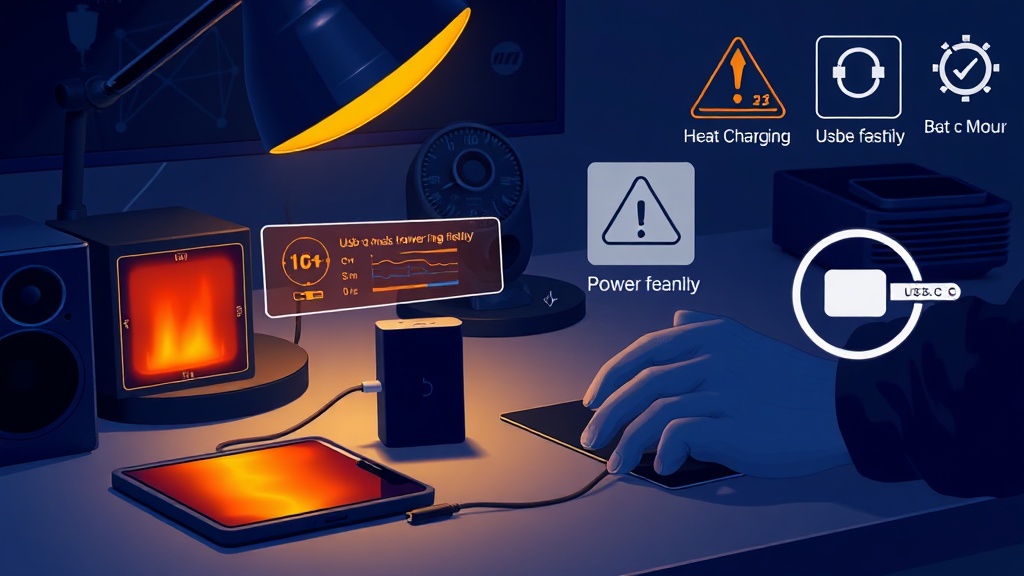
Why USB-C Safety Still Depends on Hardware QA in 2026

Alright, let's talk silicon and power delivery.
Your phone, tablet, headset, and even your “ultralight” laptop all trust one interface now: USB-C. Great in theory. In practice, in 2026, charging has become a lottery for people who treat adapters and power banks like interchangeable plastic bricks.
And the numbers this winter should make you stop shrugging at this.
The myth: one port means one quality standard
USB-C has finally become the common port shape on more devices, and in the EU the hard rules are now real: since December 2024, hands of many handhelds already need USB-C, and as of April 28, 2026, laptops join the lineup under the EU’s common charger requirements.
That doesn’t mean quality is automatic. It means everyone now ships with the same physical connector while still using wildly different quality control standards.
The USB Implementers Forum says PD 3.1 now allows up to 240W over USB-C and that USB Type-C has been updated with the 240W cable requirements.
But this headline capability and an embossed symbol on the shell are two different things when the internals are rushed.
Why QA engineers call this a safety problem, not a convenience problem
In the last quarter, we saw enough field reality to prove that.
1) INIU BI-B41 recall
INIU issued a voluntary recall on specific BI-B41 units sold on Amazon U.S. from Aug 2021 to Apr 2022. The affected units are limited by model, color, channel and batch-level serial logic: black or blue 10000mAh BI-B41 (5V/3A) with serials 000G21, 000H21, 000I21, 000L21.
The company explicitly says those units may have a battery-cell overheating risk and asks affected owners to stop use immediately and request a refund or gift card.
According to the CPSC-linked reporting CBS cited, the broader INIU BI-B41 issue had 15 overheating reports, including 11 fires. CBS says three people had burn injuries and there was property damage in the six-digit range.
You can see how this happens: a tiny defect in a batch can survive distribution and only surface in real users’ hands.
2) Belkin’s own recall confirms this pattern
Belkin has now pulled all units of the Auto-Tracking Stand Pro MMA008 and two USB-C power bank SKUs (BPB002, PB0003) after identifying a manufacturing defect in lithium-ion cells that could overheat and pose fire risk.
This is a major brand recall. This should not be interpreted as “rare black swan.” It is a reminder that safety failures are not limited to no-name eBay sellers.
When major brands, with formal QA budgets, still ship recalled lithium-based devices, buyers have zero choice but to treat every USB-C block like a potential stress test victim.
Why your checklist is now non-optional
A lot of people read “USB-C” and assume compatibility plus safety. Wrong assumption.
Capability is only part of the equation
USB-IF’s cable/compliance docs still say one thing clearly: USB-C to USB-C cables in the compliance system must be labeled for power capability (60W or 240W logos) and data rate markings before testing. In other words, even in the same connector family, the product’s actual handling of voltage/current can differ significantly.
You need to verify:
- Is the cable marked for the wattage the source and load actually request?
- Is the charger from an official recall-safe model family and not an unknown rebrand?
- Are you seeing independent QA or reliability numbers beyond “5-star” shopping comments?
The EU “common charger” changes the game on behavior, not necessarily trust
The EU ruleset does force better consumer clarity—hence labels about power requirements and whether a charger ships in-box—and unbundling rules to reduce unnecessary chargers.
What changed for users:
- More likely to reuse existing chargers.
- More likely to compare ratings by power and protocol rather than brand name.
What did not change:
- The obligation for you to inspect what you buy.
- The reality that a bad cell batch can still be inside a compliant-looking package.
The post-checklist before checkout (hard rules)
Use this before buying anything that stores or pushes high current.
Match the load before the marketing
- If your laptop claims up to 96W+ or 140W PD, don’t buy a random “60W cable” no-name brick.
- If the listing says “USB-C” only, assume 0.7x, unless the power spec is explicit.
Demand model-level recall transparency
- Search the model number with “recall” before you click buy.
- If the manufacturer has no post-sale support page, that’s already a negative.
Skip vague “compatible with USB-C PD” claims
- Compatibility claims in copy are not the same as compliance.
- USB-IF marking and model documentation matter more.
Avoid mystery battery provenance
- If it’s not sold by the listed brand’s official channel, your confidence score drops.
- For power banks, this is your #1 risk variable.
Look for local safety behavior, not unboxing theater
- Warmth at rest, intermittent charging negotiation, intermittent disconnects, and smell/odor under load are red flags.
- If it’s hot before current ramps, return it.
How I would buy charging gear this week
If I were buying for a real desk setup this week:
- I’d prioritize gear with explicit recall-history visibility and published serial-specific safety steps.
- I’d avoid anything with model-ambiguous naming and reseller-only SKUs.
- I’d verify USB icon + data/power markings before first use.
- I’d run a 15-minute controlled burn-in load test (stable current draw, heat, heat-soak, disconnect behavior) before trusting for travel.
The verdict for your wallet
USB-C didn’t solve charging safety. USB-C + weak quality control did.
The connector simplification is useful. The ecosystem is cleaner now than it was in 2018. But if manufacturers still ship dangerous lithium-cell faults at scale, the only real protection is stricter buyer behavior.
Stop treating chargers as consumables and start treating them as power infrastructure.
Stay wired.
Excerpt: USB-C is now mandatory in more markets, but charging safety is still not guaranteed. Here’s a practical hardware-audit playbook for avoiding dangerous chargers and power banks after recent recall activity.